
Pennsylvania Businesses Face October 13 2026 Skill Games Deadline

- Pennsylvania businesses that host "skill games" have until October 13, 2026 to get the machines off their premises.
- State police strongly recommend that establishments arrange removal with any distributors or vendors that own the machines and associated equipment.
- One point in the guidance is aimed squarely at a common misconception.
Pennsylvania businesses that host “skill games” have until October 13, 2026 to get the machines off their premises. The Pennsylvania State Police issued the reminder on September 9, telling taverns, restaurants, social clubs, mini-marts, gas stations, grocery stores, laundromats and pizza parlors across the commonwealth that the devices become subject to seizure beginning October 14, 2026. The deadline traces back to a state Supreme Court decision in June that classified the machines as slot machines.
What businesses need to do
State police strongly recommend that establishments arrange removal with any distributors or vendors that own the machines and associated equipment. That includes ticket redemption terminals, not just the game cabinets. State police have since launched a skill-game help page ahead of the October 13 deadline, and in Reading, state Rep. Manny Guzman scheduled a public information session on the machines for October 8.
One point in the guidance is aimed squarely at a common misconception. “Simply powering off an otherwise operable machine or unplugging them is not sufficient to comply with the law,” PSP wrote.
If a distributor refuses to collect its equipment, PSP says the establishment is “encouraged to proactively reach out to PSP to assist in their removal to ensure compliance with applicable law.”
There is no general exemption for businesses holding other licenses. Under the guidance, only licensed casinos and qualifying licensed “truck stop establishments” may possess, operate and maintain slot machines or video gaming terminals “that have been inspected and approved for operation by the PGCB.” Both halves matter: the location must be appropriately licensed and the equipment approved by the Pennsylvania Gaming Control Board. A liquor license or ordinary business license does not authorize these devices.
What enforcement could involve
October 13 is the compliance date. October 14 is when exposure to enforcement begins.
PSP has described what enforcement may involve rather than announcing a schedule of visits. According to the agency, it may include seizing and forfeiting the machines, associated equipment and money connected with their operation, along with criminal charges where deemed appropriate.
That is a description of legal authority, not a promise that troopers will arrive everywhere on October 14. But the reverse holds too: businesses keeping operable machines after the deadline are, by the state’s account, holding unlawful slot machines.
Why the court ruling matters
The deadline exists because of a Pennsylvania Supreme Court decision issued June 15, 2026, in a pair of cases including In re: Three Pennsylvania Skill Amusement Devices and litigation involving skill-game company POM of Pennsylvania. The court reversed the lower Commonwealth Court orders that had gone the industry’s way.
Writing for the majority, Justice David Wecht concluded that the devices fall within the Gaming Act’s definition of a slot machine. The reasoning turns on language the General Assembly added in 2017, when Act 42 wrote two terms into the statute: “skill slot machine,” for a device where skill predominates, and “hybrid slot machine,” for one where skill and chance both shape the outcome. Because the legislature built those categories into the definition of a slot machine, Wecht wrote, the skill element is not legally significant. Requiring a player to do more than press a button does not lift a machine out of gambling regulation.
The court did not order the machines switched off immediately. It stayed its decision for 120 days — a stay is a temporary pause on an order taking effect — and that pause runs out on October 13. During it, law enforcement was not to act against operators in reliance on the opinion, which is why the machines are still running. The window was meant to let businesses wind down and lawmakers respond. Fire companies and veterans have rallied for skill games at the Capitol. On October 9, the Supreme Court refused requests to extend the deadline.
The scale is substantial. Attorney General Dave Sunday’s office has estimated roughly 70,000 skill games operating across Pennsylvania. By comparison, the Gaming Control Board reported 24,561 slot machines in operation at the state’s casinos in July 2026.
Could the rules change?
The 2026-27 state budget passed in July and was signed by Gov. Josh Shapiro with no skill games provision, despite months of negotiation.
Lawmakers remain divided over whether and how to authorize the machines, including taxes or fees, eligible locations, machine limits and oversight. Among those who would authorize them, percentage-tax approaches have run from the 16% Sen. Gene Yaw earlier backed to the 35% endorsed by Senate Republican leaders and the 52% Shapiro proposed in February.
Yaw’s current push is different in kind. Senate Bill 1079, which he sponsors jointly with Sen. Anthony Williams, would charge a flat fee rather than a share of revenue: Yaw and Williams’s proposal calls for a $500 monthly fee per terminal and a statewide limit of 50,000 machines. Yaw promoted the bill again in a September 10 statement as the deadline closed in. Rep. Russ Diamond has since urged a skill-games deal. Reps. Brad Roae and Manny Guzman have proposed pushing the deadline back six months, to April 13, 2027, though neither had filed a bill as of September 22.
In the House, Rep. Russ Diamond announced plans on September 1 for two bills addressing skill games and property-tax relief, taxing the machines at 20%. Rep. Kerry Benninghoff’s House Bill 1619, introduced in June 2025, would add no new tax, and Rep. Danilo Burgos proposed monthly fees and a statewide cap in a February 9 co-sponsorship memo.
All of it remains a proposal. Senate Bill 1079 and Benninghoff’s House Bill 1619 both sit at committee referral, and neither a bill nor a co-sponsorship memo moves the deadline. PSP’s September 9 guidance sets October 13 as the compliance deadline, with enforcement possible beginning October 14.
What owners should do now
Beyond arranging pickup, the firm Barley Snyder has advised operators to review every agreement tied to the machines for contractual exposure. The firm also warned that continued use after the deadline could breach lease provisions prohibiting unlawful activity, depending on the lease’s wording.
A booked collection date is not the same as a machine that has left the building, so confirming a pickup in writing is sensible — but removal itself is what is being asked for.
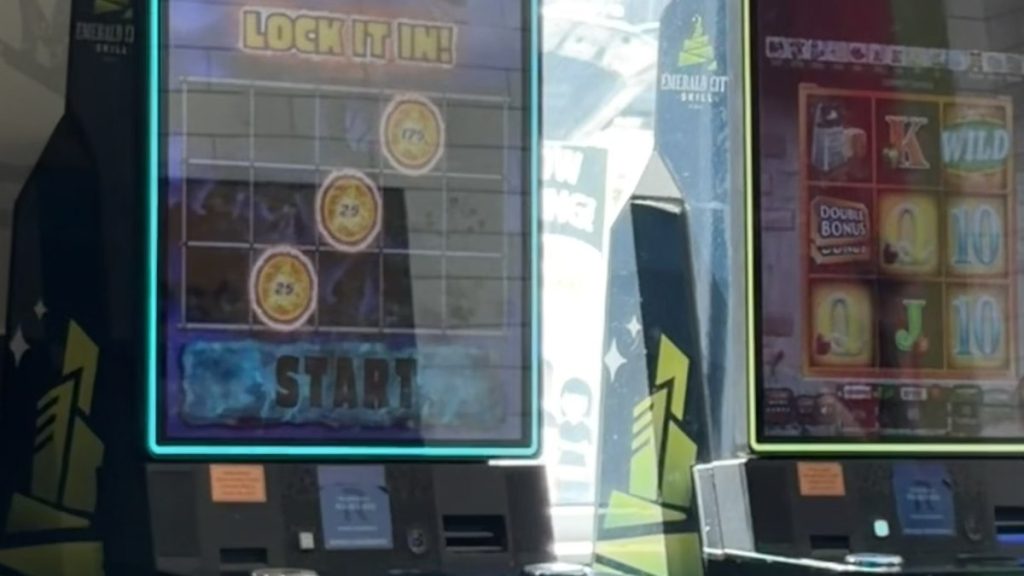
Featured image: Skill game machines in a gas station. Illustrative image. Photo: Catboy69 / Wikimedia Commons, CC0
