
A $1.50 Call of Duty Dispute Triggered a Swatting That Killed an Uninvolved Father

- Andrew Finch was 28.
- On the night of December 28, 2017, he went to his front door to find out why police were surrounding his house.
- He was shot about ten seconds later.
Andrew Finch was 28. He lived on McCormick Street in Wichita with his mother, his sister, his niece and two family friends, and he had two young children of his own. His family called him Andy.
On the night of December 28, 2017, he went to his front door to find out why police were surrounding his house.
He was shot about ten seconds later. He was unarmed. The shooting was fatal.
Officers had been told a man inside had shot his father in the head and was holding the rest of the family hostage. None of it was true. Finch had not placed a bet, played the match, or spoken to anyone involved in the argument that sent them to his address.
The argument
It began in a game of Call of Duty: WWII. Casey Viner and Shane Gaskill were on the same team, playing for a $1.50 wager — a bet between players, not anything the game’s publisher ran. Their team lost, and reporting traces the falling-out to a friendly-fire incident in which Gaskill killed Viner’s character.
Viner was in Ohio. Gaskill was in Wichita. Viner, according to the Justice Department, asked a third man to settle it for him — Tyler Barriss, in Los Angeles, known in online circles for making hoax emergency calls.
Swatting means reporting a fabricated emergency — a shooting, a hostage situation, a bomb — to send armed police to someone else’s address. It is a tool of harassment and retaliation, and one of several kinds of serious crime federal prosecutors have traced back to online gaming communities. The name describes the response the caller wants, not the unit that actually turns up.
“Swatting is no prank,” U.S. Attorney Stephen McAllister said after Barriss was sentenced. “Sending police and emergency responders rushing to anyone’s home based on utterly false information as some kind of joke shows an incredible disregard for the safety of other people.”
How the call reached a stranger’s house
This is what separates the case from a dispatching error.
Gaskill knew Barriss was circling him online. Rather than back off, prosecutors said, he dared Barriss to go through with it — and handed him an address he claimed was his own. He had lived there once. He no longer did. Andrew Finch’s family did.
Neither Viner nor Barriss knew that. The Justice Department’s account is blunt: “Gaskill fooled Barriss.”
Barriss called Wichita police from California and reported a killing and a hostage situation at 1033 W. McCormick. Officers arrived believing they faced a barricaded shooter holding family members at gunpoint.
The shooting
Officer Justin Rapp fired the shot. He was roughly forty yards from the front door and had been in position about forty seconds when it opened.
What happened in the next ten seconds is disputed, and the fullest account of it is the Tenth Circuit’s 2022 opinion in the family’s civil case. Because that appeal turned on qualified immunity, the court accepted the district court’s findings and read disputed facts in Finch’s favour — it was “bound by those findings for the purposes of this appeal.” What follows is sworn testimony, not a jury’s conclusion.
Officers on different sides of the house shouted commands over one another. Some later said they could not make out what a colleague on the north side was saying. None of them identified themselves as police.
Finch raised his hands, about to ear level. “Officers, including Rapp, could see Finch was not holding anything in his hands,” the court wrote.
Then he lowered them, and the accounts diverge. One officer saw nothing threatening. Another was unsure whether a movement toward Finch’s back was a reach or a man steadying himself. A third thought he was going for a weapon. Rapp testified that Finch lifted the side of his hoodie the way someone draws a firearm, and that he believed he saw a gun.
About ten seconds after the door opened, Rapp fired one rifle shot into Finch’s chest. Finch was not armed. Shortly afterwards, police established there had been no murder and no hostage situation in the house.
The Sedgwick County District Attorney’s office did not charge him. He was later promoted to detective, according to lawyers for the Finch family.
Tyler Barriss, who made the hoax call, was sentenced to 20 years in federal prison, according to the Justice Department — at the time, reported as the longest sentence imposed in the United States for swatting. For the Wichita incident he pleaded guilty to making a false report resulting in death, cyberstalking and conspiracy, but the 20 years was not punishment for one phone call. It resolved a plea covering dozens of federal charges across multiple jurisdictions, including bomb threats to federal buildings in Washington, D.C. He was not convicted of murder.
Casey Viner asked Barriss to do it. In September 2019 he got 15 months, two years of supervised release and $2,500 in restitution, after pleading guilty to conspiracy and obstruction of justice — he had tried to wipe his phone of his messages with Barriss and Gaskill.
Shane Gaskill gave the address. His case took the longest. Coverage that still has him on deferred prosecution is out of date: he pleaded guilty to wire fraud in May 2022 and was sentenced that September to 18 months.
The lawsuit
Finch’s family sued. The district court refused Rapp qualified immunity, though it would not let claims against the City of Wichita itself proceed. Rapp appealed and lost.
In July 2022 the Tenth Circuit held that, on the version of events accepted for the appeal, Rapp had violated clearly established constitutional law — a jury could find he shot Finch “even when a reasonable officer would have known Finch was unarmed and posed no threat.” That was not a conviction, and not a jury’s finding of liability. It meant the case could go to trial.
It never got there. On March 14, 2023, the Wichita City Council voted 6–1 to approve a $5 million settlement, ending five years of litigation. AIG was among the funding sources. The settlement resolved the civil claim without a jury verdict.
“We know that there is nothing we can do … to bring a loved one back,” Mayor Brandon Whipple said during the vote. “But we do hope this brings closure.”
The MacArthur Justice Center, which represented the family, called the shooting unjustified and the settlement a step toward holding the city accountable — the words of the plaintiffs’ lawyers, not findings of a court.
The family put it differently.
“While this settlement will not bring back our beloved Andy, it helps bring some closure as our family moves forward, especially Andy’s two young children,” said Lisa and Dominica Finch, his mother and sister.
All three men who set the call in motion went to prison. Rapp never faced a criminal charge.
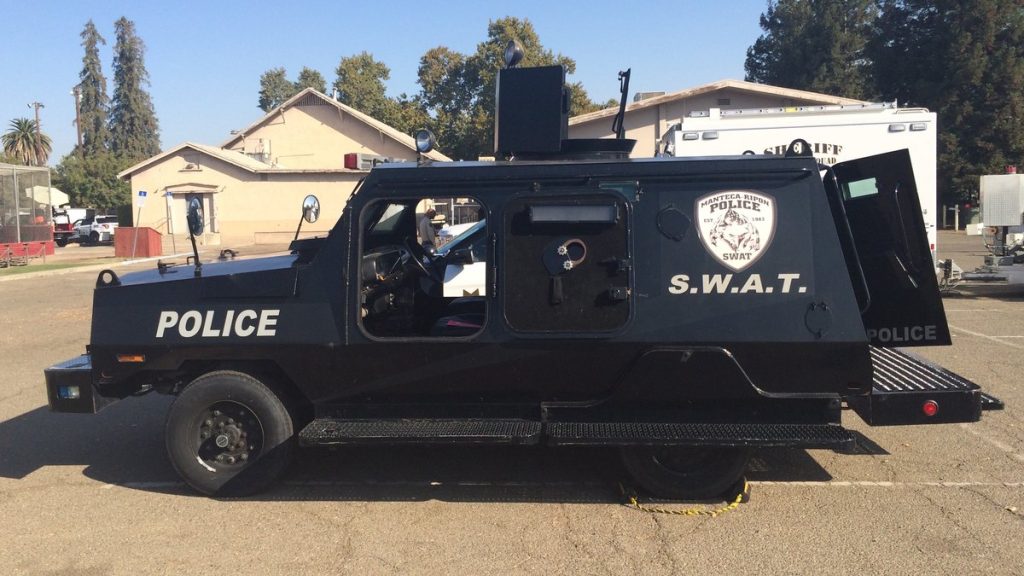
Featured image: A police SWAT vehicle in California. Illustrative image; not a vehicle involved in the case. Photo: TaurusEmerald / Wikimedia Commons, CC BY-SA 4.0
