
The Average American Gamer Is 37 — So Why Does Gaming Still Get Treated Like a Kids’ Hobby?

- The average American gamer is 37 years old.
- GameEmpress covered those raw numbers when the ESA's 2026 report came out.
- The "kids' hobby" framing isn't pulled from nowhere.
The average American gamer is 37 years old. That’s not a rounding error or a one-year fluke — it’s the Entertainment Software Association’s official figure for 2026, up from 36 in 2025. Across the country, 212.3 million Americans — 67% of the population ages 5 to 90 — now play at least an hour of video games a week.
GameEmpress covered those raw numbers when the ESA’s 2026 report came out. What that piece didn’t get into is the more interesting question underneath the data — if the average gamer is closer to 40 than to 20, why does “gaming” still get talked about, culturally, like it’s something that happens in a kid’s room and nowhere else in the house?
Two Decades Ago, the Average Gamer Was Much Younger
The “kids’ hobby” framing isn’t pulled from nowhere. Two decades ago, the average U.S. gamer really was 29 years old, according to an AFP wire report on the 2026 ESA figures — a figure the ESA itself confirms. Twenty-nine is an adult, not a kid, but it’s still young enough that the cultural shorthand of “gamer equals young person” had more truth to it then than it does now.
ESA president and CEO Stanley Pierre-Louis put it plainly to AFP: the current numbers “mirror in large part the demographics of the nation.” The players didn’t stay young while everyone else aged around them — the same people who grew up on consoles simply kept playing, and were joined by a wave of adults who picked the hobby up later in life.
Most Parents Are Gamers Themselves — the Data Says So
The clearest evidence against the “kids’ hobby” idea doesn’t come from the general population numbers at all. It comes from the ESA’s own breakdown of parents specifically. Per the ESA’s June 2026 report, 75% of American parents play video games every week themselves. Of those, 81% say they game together with their kids, and more than half do it at least weekly.
Nearly half of parents whose children play — 49% — say they believe gaming teaches skills like problem-solving and creative thinking. And two-thirds of parents use parental controls, a figure that climbs to 70% among parents of kids 12 and under. These aren’t the numbers of a hobby parents are outside of, watching through a doorway. They’re the numbers of a hobby most parents are already inside.
So Why Does the “Kids’ Hobby” Idea Persist?
To be clear about what isn’t backed by data here: no survey has directly asked parents to guess the average gamer’s age, so there’s no clean statistic showing a “perception gap” in numbers. What exists instead is circumstantial, but it points the same direction.
Playable characters themselves skew young. AARP’s research arm analyzed 49 best-selling 2023 games on Steam and found that just 7% of human and humanlike preset characters were 50 or older, and 69% of older gamers said in AARP’s survey that they feel games “aren’t designed for their age group.” That’s a narrower finding than a claim about how the industry markets itself broadly — but it’s still real evidence that the people games put on screen don’t look like the people actually playing them, which helps explain why the public image of “who plays” lags behind who actually does.
What Parents Actually Say About Their Kids’ Gaming
The disconnect isn’t about whether parents play — the ESA numbers settle that. It’s about how parents talk about their kids’ gaming specifically, and a Marist Poll from July 2025 is one of the more detailed looks at that. Surveying 876 parents of children under 18, Marist found 48% describe gaming’s effect on their kids as mostly positive, 36% as neutral, and 15% as mostly negative.
The poll also found a split by gender: 57% of fathers rated the effect positive, versus 38% of mothers. Among parents whose children have access to games, 27% said they play together daily, 38% weekly, and 12% monthly. And 66% of parents whose children play video games say they set daily time limits. None of that reads like parents who see gaming as somebody else’s activity. It reads like parents actively managing something they’re already part of.
A Site Built on This Disconnect
GameEmpress ran into this exact gap directly while reporting on why some GTA players choose to roleplay as police officers instead of causing chaos. The piece opens with a father who expected the worst from handing his four-year-old a controller in a game literally named after grand theft — and found something closer to a kid experimenting with rules, not breaking them.
The Real Takeaway
The average American gamer is 37 — old enough to have a mortgage, a career, and quite possibly a kid who also plays. The data doesn’t show parents standing outside gaming looking in. It shows most of them already playing, already setting limits, and already forming opinions about it from the inside. The “kids’ hobby” framing isn’t wrong because kids don’t play — they do, at some of the highest rates of any group. It’s incomplete because it leaves out almost everyone else in the room.
Sources: Entertainment Software Association, “Two-Thirds of Americans Play Video Games Every Week,” June 3, 2026; AFP, via TechXplore, “US gamers getting older as industry reports growth,” June 7, 2026; Marist Poll, “Parents and Video Games,” July 2025; AARP Research, “Aging in Play: Representations of Age in Video Games,” March 11, 2025.
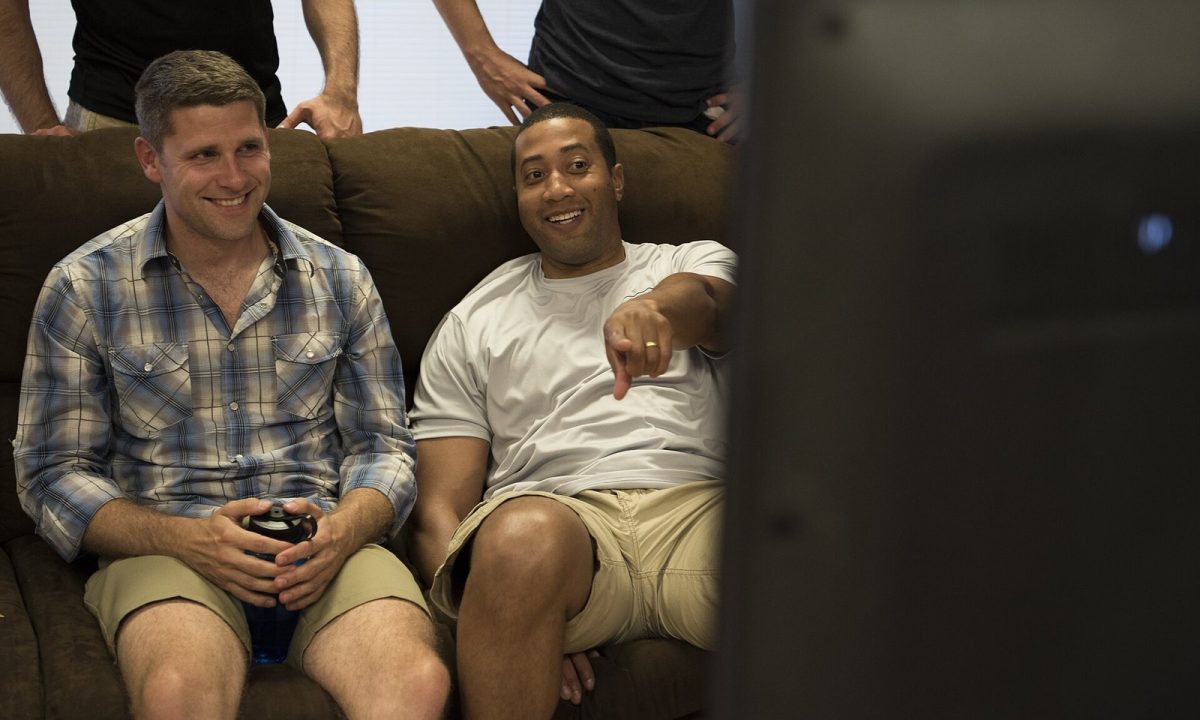
Featured image: Two adults play a console game during a tournament. Illustrative image. Photo: U.S. Air Force / Airman William Tracy (public domain)
