
Mexico: Take-Two Loses Its Fight to Keep a ROCKSTAR GAMES Trademark

- Take-Two Interactive has lost a Mexican trademark registration for ROCKSTAR GAMES that covered video game software.
- The case was brought by Seven Audio, S.A.
- I followed the case through three sets of public records.
Take-Two Interactive has lost a Mexican trademark registration for ROCKSTAR GAMES that covered video game software. On November 5, 2026, a federal appeals court in Mexico City unanimously turned down Take-Two’s challenge to the cancellation. Two weeks later, Rockstar Games released Grand Theft Auto VI.
The case was brought by Seven Audio, S.A. de C.V., a Mexico City company that owns an older ROCK STAR trademark for audio equipment and computers.
I followed the case through three sets of public records. The first is the gazette of Mexico’s Institute of Industrial Property (IMPI), the country’s trademark office. The second is the Federal Court of Administrative Justice (TFJA), which reviews IMPI’s decisions. The third is the federal judiciary’s case portal, where the appeals court logs its rulings.
A ROCK STAR mark that came first
The dispute starts with a mark registered years before the earliest Take-Two ROCKSTAR filing I found in IMPI’s records. The IMPI gazette shows registration No. 644324, a ROCKSTAR name with a logo that IMPI’s database now lists as ROCK STAR, was filed on December 17, 1999, and granted on February 28, 2000, to a different company, King Audio, S.A. de C.V.
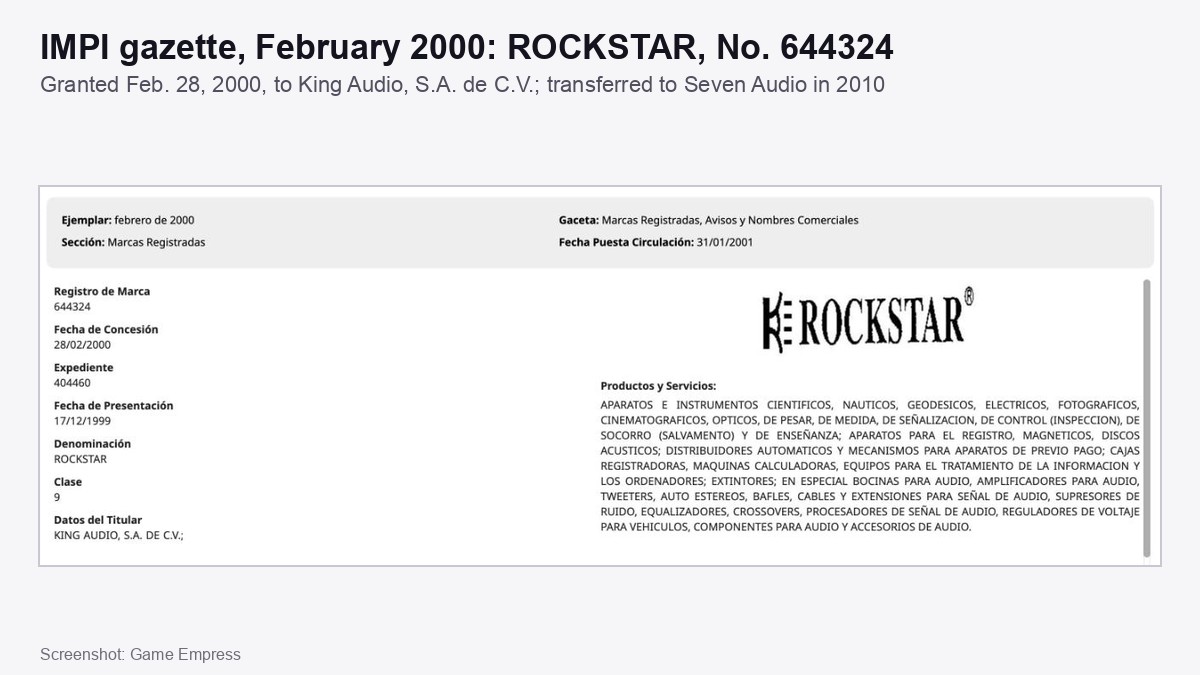
The gazette’s October 2010 issue records the transfer of the mark to Seven Audio. The registration covers goods including audio components, speakers, amplifiers, car stereos, data processing equipment and computers. IMPI’s database lists it as valid until December 17, 2029.
Take-Two’s own attempts at the name in Mexico started with an application for ROCKSTAR GAMES in game software, filed on September 8, 2008. The trademark office’s records show it closed in July 2009 without a registration.
Take-Two later went after the older mark itself. In a case opened in 2013, it asked IMPI to cancel the registration for non-use, and IMPI denied the request in 2014. In 2017, it filed a new cancellation claim and an invalidity claim. IMPI denied both in 2018, and later rulings in 2021 and 2025 kept that result in place.
How ROCKSTAR GAMES was cancelled
Seven Audio then turned the same tool on Take-Two’s registrations. The one at the center of the November ruling is No. 1738269, ROCKSTAR GAMES in Class 9. IMPI’s trademark database lists its goods as software for video games and computer games (my translation). Take-Two filed for it on June 1, 2016, and IMPI granted it on March 29, 2017.
In Mexico, a registration can be cancelled if it goes unused for three years in a row. IMPI applied that rule, under Article 260 of the Federal Law for the Protection of Industrial Property, when it cancelled ROCKSTAR GAMES on May 21, 2025.
According to the TFJA judgment, IMPI found that Take-Two had not used the mark for the goods it covers between January 26, 2021, and January 26, 2024. The ruling appears in the IMPI gazette under proceeding P.C. 169/2024 (C-50).
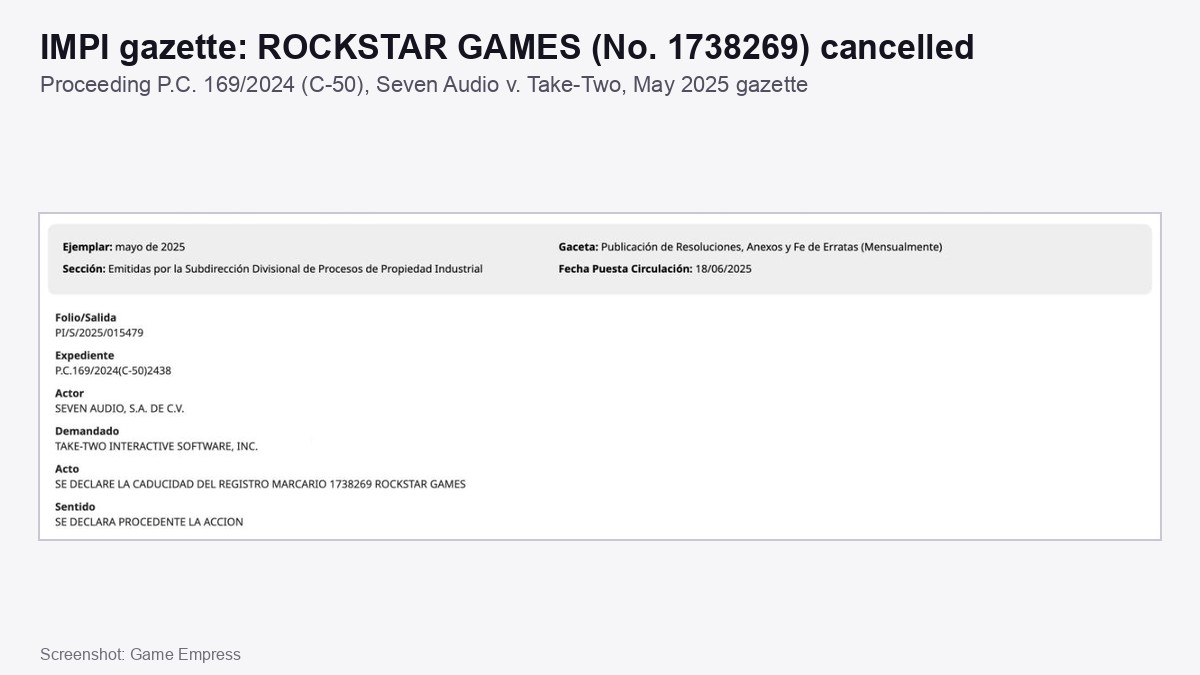
Take-Two took the decision to the TFJA on July 10, 2025, in case 1279/25-EPI-01-7. In a judgment dated February 27, 2026, the court found that Take-Two had not proved its claims and upheld the cancellation, as the TFJA’s case bulletin also records.
That left an amparo directo, a constitutional challenge to the TFJA judgment, heard by the Sixth Collegiate Court in Administrative Matters of the First Circuit as case No. 237/2026.
The court’s docket shows the case was listed for decision on October 29 and decided on November 5 by a unanimous vote. It records the result as “No ampara,” meaning the court did not grant Take-Two’s challenge. Seven Audio had filed its own amparo in support of the TFJA ruling.
It’s not just ROCKSTAR GAMES
Seven Audio has won similar rulings against eight more Take-Two registrations, though not all of them are final. This is where each one stood in the records I checked between November 18 and November 21, 2026:
| Registration | What it covers | What happened |
|---|---|---|
| ROCKSTAR GAMES, No. 1738269 | Video game software (Class 9) | Cancelled for non-use, May 2025. TFJA upheld the cancellation February 27, 2026. Appeals court denied Take-Two’s amparo November 5, 2026. |
| ROCK STAR, No. 1738268 | Video game software (Class 9) | Cancelled for non-use, May 2025. TFJA upheld the cancellation March 20, 2026. Take-Two’s amparo (No. 321/2026, Third Collegiate Court) had no decision as of November 20. |
| ROCKSTAR PASS, No. 1695239 | Downloadable game software (Class 9) | Declared invalid by IMPI in early 2025. The TFJA had ruled for Seven Audio in June 2024 after a federal appeals court decision in its favor. |
| ROCKSTAR NORTH, No. 1695244 | Video game software (Class 9) | Cancelled for non-use, December 2025, after the TFJA ordered IMPI to decide the case. |
| ROCKSTAR GAMES, ROCKSTAR PASS, ROCKSTAR NORTH and ROCKSTAR STUDIOS (Nos. 1111359, 1279223, 1315604, 1268320) | Entertainment services (Class 41) | All four cancelled for non-use in 2023 and 2024. The TFJA had ruled for Seven Audio in 2022, and four appeals courts left those rulings in place in 2023. |
| ROCKSTAR GAMES, No. 1288410 | Toys and games (Class 28) | Cancelled for non-use in a ruling published in IMPI’s August 2026 gazette. |
The appeals judges did not always agree. One of the four Class 41 rulings, issued by the Seventeenth Collegiate Court on March 9, 2023, was a majority decision with a dissenting opinion.
The cases Seven Audio lost
The record is not one-sided. Besides its non-use cases, Seven Audio also asked IMPI to declare some Take-Two marks invalid, meaning they should never have been granted.
In 2018, IMPI rejected three of those requests: ROCKSTAR TV and ROCKSTAR NORTH for software, and ROCKSTAR GAMES for toys. It rejected the ROCKSTAR NORTH and toys requests again in rulings issued under court orders in 2021 and 2022.
Seven Audio lost one of its own marks along the way. In 2018, IMPI declared its ROCK STAR registration for games and toys, No. 1704508, invalid in a case where Seven Audio was the defending party, and it confirmed that result in 2022.
Seven Audio’s invalidity cases against the two Class 9 marks at the top of the table, ROCKSTAR GAMES and ROCK STAR, have moved back and forth between IMPI and the courts since 2017. IMPI’s most recent rulings in those cases, in 2022 and 2024, did not decide the merits.
GTA VI is on sale, and Take-Two is still filing
All of these rulings concern trademark registrations. None of the records I reviewed orders any game to be removed from sale in Mexico. Grand Theft Auto VI launched on November 19, and Take-Two said on November 20 that the game’s day-one retail sales reached $3.79 billion.
Take-Two has not stopped applying for the name. The IMPI gazette for October 2026 lists a new batch of ROCKSTAR applications filed on October 22, and IMPI’s database shows at least 11 recent filings in Take-Two’s name for ROCKSTAR GAMES, ROCKSTAR PASS, ROCKSTAR STUDIOS, ROCKSTAR TV and an R ROCKSTAR logo. They join earlier Take-Two ROCKSTAR applications that IMPI lists as pending.
Seven Audio has a pending application of its own, ROCK STAR No. 1650395, filed on August 27, 2015, which covers software among other goods.
Mexico is not the only place where Rockstar’s trademarks are being contested. In the US, a North Carolina firm has asked the USPTO to cancel one of Rockstar’s logo registrations, even as Take-Two keeps filing new trademarks around GTA 6.
I asked Take-Two and Rockstar Games for comment on November 20, 2026, including whether the rulings affect sales of Rockstar games in Mexico. Neither company had responded by the November 25 deadline I gave them, or by the time this story was published.
How I checked this story
- IMPI gazette (SIGA): the cancellation, invalidity and compliance rulings described above, the 2000 grant of No. 644324 to King Audio, and the 2010 transfer to Seven Audio.
- IMPI trademark database (MARCia): owners, classes, goods and filing dates for each registration and application.
- TFJA case bulletin and the public version of the February 27, 2026, judgment in case 1279/25-EPI-01-7, plus case 1280/25-EPI-01-1 and the 2022 cases behind the Class 41 cancellations.
- Federal judiciary case portal: amparo directo 237/2026 (decided November 5, 2026), amparo directo 321/2026 (pending), and the four 2023 amparo rulings in the Class 41 cases.
- I checked the records between November 18 and November 21, 2026. Some public court entries redact the parties’ names; in those cases I matched the case numbers across the IMPI, TFJA and federal court records.