
New Jersey: Investors Say Telegram Game Studio Founder Took Their Money as a “Loan” to Trade Crypto

- Seven investors who put $275,000 into Loot Labs, a startup that pitched investors on Telegram games built on the TON blockchain, are suing its founder.
- The lawsuit was filed Nov.
- The claims are allegations and have not been tested in court.
Seven investors who put $275,000 into Loot Labs, a startup that pitched investors on Telegram games built on the TON blockchain, are suing its founder. They say he treated their money as a personal “loan,” traded it for himself and never gave it back.
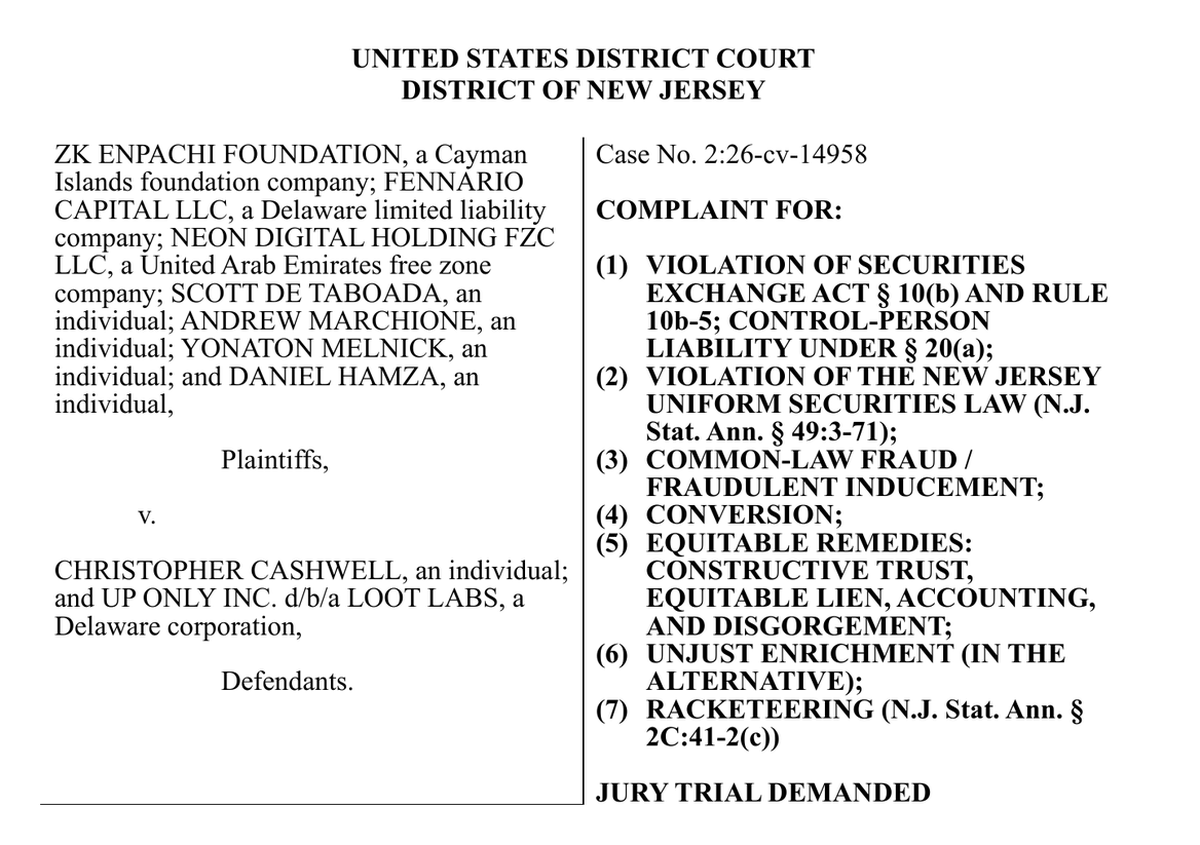
The lawsuit was filed Nov. 20, 2026, in U.S. District Court in New Jersey, case No. 2:26-cv-14958. It names founder Christopher Cashwell and his company, Up Only Inc., which did business as Loot Labs. The investors accuse them of securities fraud, common-law fraud, conversion and racketeering under New Jersey law.

The claims are allegations and have not been tested in court. GameEmpress read the full 28-page complaint and checked the biggest transfer it describes on the public Ethereum blockchain.
The pitch: “casino” and “wager” handles for TON games
According to the complaint, Up Only raised money in the late summer and fall of 2024 as Loot Labs, a “Telegram-first blockchain venture studio.” Its co-founder and chief executive, Henry Felella, made the pitches. Cashwell supplied what Felella told investors about the product and the Telegram handles. Felella is not a defendant.
At the TOKEN2049 conference in Singapore on Sept. 18 and 19, 2024, Felella told two of the investors that the company could acquire Telegram handles such as “casino” and “wager” for games on the TON blockchain. The money raised, he said, would fund those games and the handles, the complaint says.
Investors were also told that the company’s exchange was “already almost done,” that it had “1.5M raised from F&F,” and that it had “$2M+ committed so far from angels” toward a $5 million seed round. The complaint says none of that was true. The whole raise brought in about $570,000, and the exchange never launched.
The seven plaintiffs, three companies and four individuals, put in between $5,000 and $100,000 each. They bought a “Loot Labs SAFE + Token Warrant,” an early-stage deal that promises future equity and tokens.
The “loan”
The case rests largely on private messages between Cashwell and Felella that the complaint quotes. On Sept. 27, 2024, with investor money already in the company’s treasury, Cashwell wrote: “The easiest way to avoid gains is to do it as a loan to me and let me trade under my trader status.” The complaint says Felella took part in that exchange.
Over the next months, the complaint says, money moved from the treasury to wallets Cashwell controlled, starting with $50,000 in the stablecoin USDC on Oct. 2, 2024.
By December, the venture was winding down. When Felella asked Cashwell to return the investors’ money to the company, he refused, according to the complaint, writing: “I’m gonna print some more before reverting capital.” In January 2025, he told Felella that investors had “zero right” to a refund under their agreements. The lawsuit says no such term exists.
The $255,600 transfer
On Feb. 5, 2025, one investor, ZK Enpachi Foundation, sent Cashwell a demand letter asking for its money back. The next morning, the complaint says, Cashwell used two keys he controlled to move about $255,600 out of the treasury.
GameEmpress checked that transaction on the public Ethereum blockchain. It shows a successful transfer at 10:55 a.m. Eastern on Feb. 6, 2025, in block 21,788,494, moving 219,107.99 USDC and 36,500 USDT out of the treasury wallet the complaint names. The blockchain record shows where the money went, but not who controls the receiving wallet. The complaint says that wallet was Cashwell’s.
The day after the transfer, Cashwell told an investor that the planned product was “a non-starter due to recent changes in tg miniapp policies,” the complaint says. A March 2025 update to investors said the company had “halted development of blockchain-native apps on Telegram.” The same update said it had “>36 months of operational runway.”
In April 2025, an investor asked why the company did not simply wind down and return the money. Cashwell replied that “a bit over 25% of the funds have been spent and doing so would mean I come out of pocket like $150k,” according to the complaint.
He later told another investor: “I can’t believe you honestly think I traded with and lost investor funds. I’d literally never do that.”
What the investors want
The investors want their $275,000 back, plus punitive damages and triple damages under New Jersey’s racketeering law, which the complaint puts at $825,000 in all. That total includes the original investment rather than adding to it.
They also ask the court to place the two wallets they say Cashwell used, and any trading gains made with their money, in a constructive trust. The investors are represented by the law firm Fishkin Lucks LLP.
Disputes over investors’ crypto have reached other courts this year. In Connecticut, a man pleaded guilty after gambling away investors’ crypto on Stake.com.
In the Loot Labs case, CourtListener’s copy of the docket, last updated Nov. 20, showed no response from Cashwell or Up Only as of Nov. 23.