
PETAFAB Dev Says AMD and Intel Have Reproduced the Windows Driver Bugs Blocking His Game on Some PCs

- Engineers at AMD and Intel have reproduced the Windows driver bugs that stop PETAFAB: Bot Invasion from running on some PCs, the game's developer, Sebastian Aaltonen, told Game Empress.
- Aaltonen, a Finnish engine programmer who released the destructible first-person shooter on Steam on November 6, 2026, answered our questions by email on November 8.
- The game's Steam page already warns players about the problem.
Engineers at AMD and Intel have reproduced the Windows driver bugs that stop PETAFAB: Bot Invasion from running on some PCs, the game’s developer, Sebastian Aaltonen, told Game Empress. There is no date yet for fixed drivers.
Aaltonen, a Finnish engine programmer who released the destructible first-person shooter on Steam on November 6, 2026, answered our questions by email on November 8. “AMD and Intel engineers have been able to repro the bugs internally in their Windows drivers,” he wrote. “There’s currently no ETA available for a fixed Windows driver release date.”
Which graphics cards are affected
The game’s Steam page already warns players about the problem. It says the game is not compatible with Intel GPUs or Nvidia’s GTX 10-series cards, and that AMD’s RX 6000 series, which uses the RDNA2 architecture, “has a known driver bug.” It also asks for Vulkan 1.4 and an October 2026 Nvidia or AMD driver.
Aaltonen’s answers narrow that down. On AMD, he said, only older RDNA2 cards are affected, while the Intel bug “affects their whole Windows lineup.” The problem is limited to Windows: both companies’ Linux drivers “work already perfectly” with the game, and RDNA2 hardware runs it fine on SteamOS, the system on Valve’s Steam Deck.
He did not mention Nvidia’s GTX 10 series in his reply, so the Steam page’s warning about those cards still stands. For players on Intel graphics or older RX 6000 cards, the practical answer for now is to wait for driver updates from AMD or Intel.
What Codex made, and what it didn’t
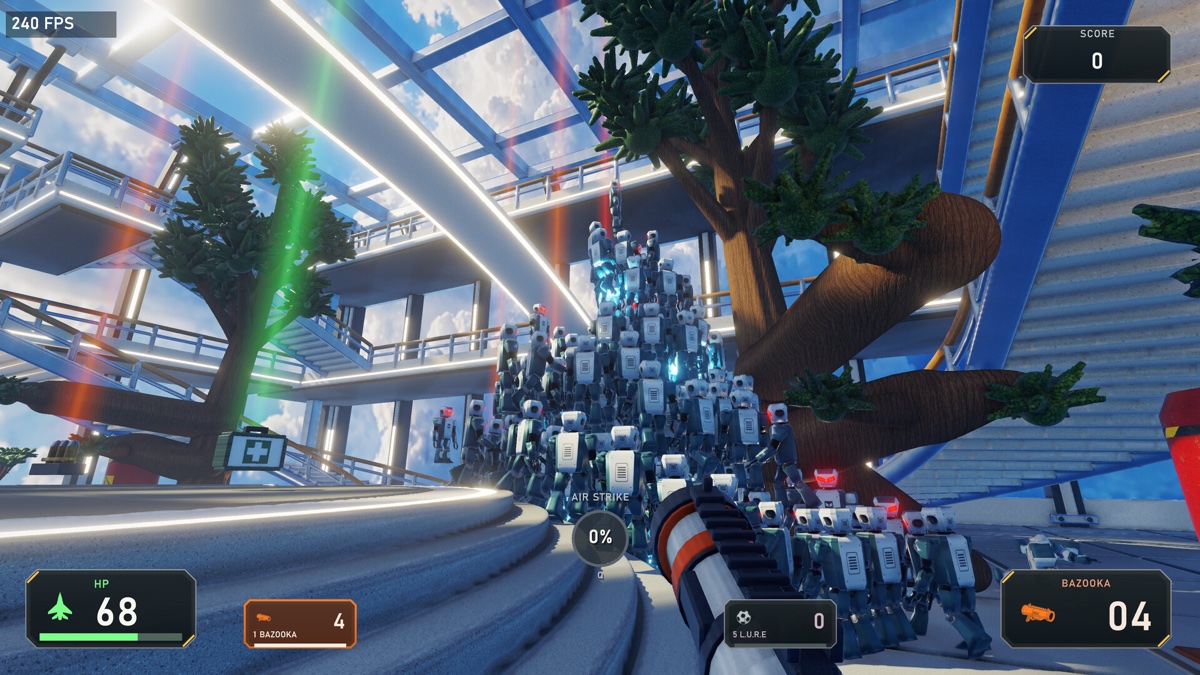
The Steam page’s AI disclosure says only that “Codex helped with graphics production.” We asked Aaltonen what that meant in practice. Codex, OpenAI’s coding agent, “produced nine 3d models for the bots by remote controlling Blender,” he said, along with a set of small tiling textures.
Much of the rest of the game was not built from traditional art at all. The game has no traditional animations; movement is driven by the physics and the game engine. The levels are built from distance functions, mathematical shapes that the engine draws, using technology similar to the tech behind 2018’s Claybook. Aaltonen said he built that original tech and that his company owns it. The character art was hand-painted by an artist he named as Enit, and the soundtrack and audio come from composer Ari Pulkkinen and his team.
Why a 1 GB game runs on its own engine
PETAFAB needs only about 1 GB of storage, small next to most new PC games, which now need twice the space they did in 2016. Aaltonen credits his own engine for that. “I have been an engine/rendering programmer for 30 years working at big tech companies,” he said. “It’s natural for me to write a small game engine for my own games.”
He has done it before. He said he sold his first engine to Frozenbyte, which used it for games including Shadowgrounds and Trine, and that he later led the engine team at a Ubisoft studio. A custom engine, he said, lets the game run at a smooth 90Hz on the Steam Deck OLED and a locked 540Hz on fast esports PCs, and on Linux it already runs on 4GB Intel GPUs.
A quiet launch, and Steam Workshop next
Aaltonen was candid about sales and attention. “Launch visibility hasn’t been great,” he said. “I have great technical expertise, but I am not a marketing mastermind.” His contacts are mostly in the tech world, where he is invited to speak at conferences every year, rather than among players and game media.
Those who have played it seem to like it. All 16 user reviews on Steam were positive when we checked on November 8, though Steam showed only two people playing at that moment.
The next update is aimed at those players. Aaltonen said the next patch will add Steam Workshop support and tools to let players build their own levels, because they want to use the game’s destruction and fluid simulation as a physics sandbox. He did not give a date for the patch.
PETAFAB: Bot Invasion costs $9.99 on Steam for Windows and Apple Silicon Macs.