
Washington: Playtika Loses Bid to End State’s Social Casino Lawsuit, SEC Filing Says

- A King County judge has refused to throw out Washington's lawsuit against Playtika over its social casino apps, the mobile game company says in a quarterly report filed with the SEC on November 5, 20…
- The court denied Playtika's motions to dismiss on September 22, the filing says.
- The state filed the case on February 3, 2026.
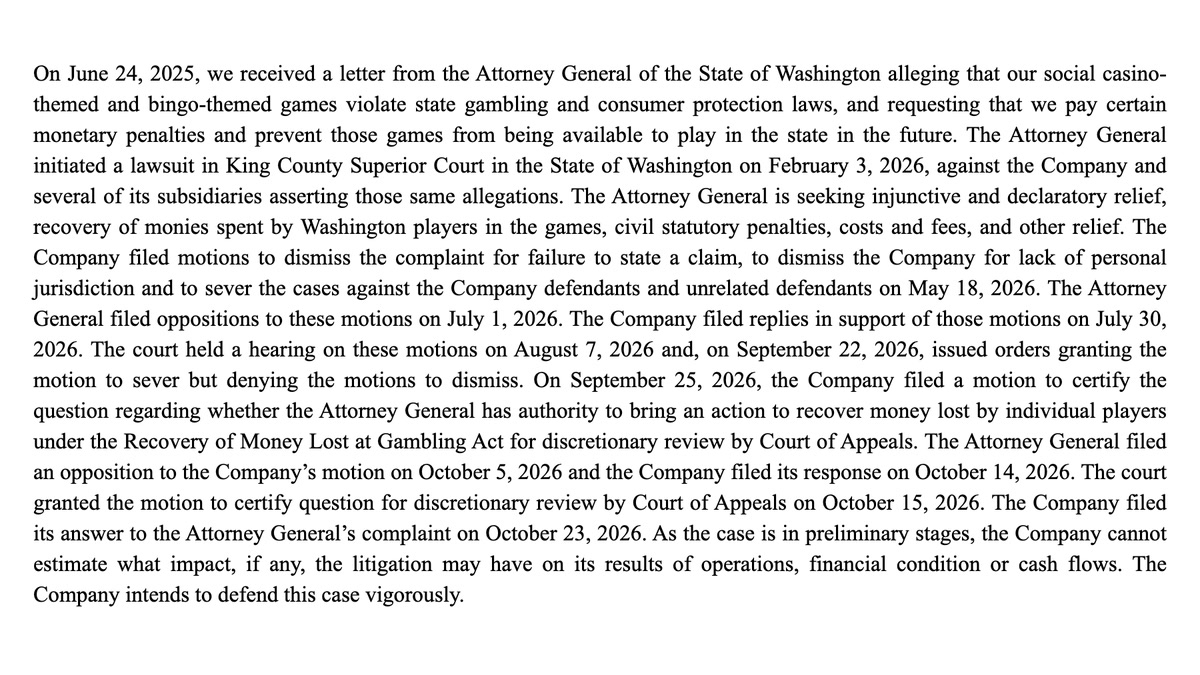
A King County judge has refused to throw out Washington’s lawsuit against Playtika over its social casino apps, the mobile game company says in a quarterly report filed with the SEC on November 5, 2026.
The court denied Playtika’s motions to dismiss on September 22, the filing says. On October 15, it certified one question for possible review by the state Court of Appeals: whether Attorney General Nick Brown can sue to recover money that individual players lost.
A lawsuit over 16 casino-style apps
The state filed the case on February 3, 2026. The clerk’s stamp on the complaint gives the case number as 26-2-04647-6 SEA. It names five Playtika companies and six Aristocrat companies, including Product Madness and Big Fish Games.
The complaint says the 16 apps, among them Slotomania, Bingo Blitz and Big Fish Casino, offer unlicensed online gambling, with players buying coins, chips or credits to stake on slots, poker, bingo and scratchcards. It says Washington players spent over $151 million in Playtika’s apps and over $74 million in Aristocrat’s since September 2020.
These are the state’s allegations; the court has not ruled on whether the apps break Washington law. Playtika says in the 10-Q that it intends to defend the case “vigorously.” It filed its answer to the complaint on October 23.
What the judge decided in September
Playtika filed three motions in May. Two sought dismissal: one argued the complaint failed to state a legal claim, the other that the court had no power over the parent company, Playtika Holding Corp. The third asked the court to split the claims against Playtika’s companies from those against what the filing calls “unrelated defendants,” whom the complaint groups as Aristocrat.
After an August 7 hearing, the judge granted the split and denied both dismissal motions. A denial is not a finding that the apps are illegal; it means the state’s case goes on. The 10-Q does not say how the claims against Aristocrat, the slot maker now suing PAYDAY publisher Starbreeze in Nevada, will proceed.
What a “certified question” means here
Three days after losing, Playtika asked the judge to certify a question for the Court of Appeals: does the attorney general have the authority to sue to recover money lost by individual players under Washington’s Recovery of Money Lost at Gambling Act? The AG opposed the request. The judge granted it on October 15.
Washington’s appeal rules let a party seek “discretionary review” of a trial-court decision that cannot be appealed as a matter of right, as the 2024 Court of Appeals decision Wade v. Rypien explains. One route is certification. The trial judge certifies that the order involves “a controlling question of law” with “substantial ground for a difference of opinion,” and that an early review could help end the case sooner.
Certification does not put the question before the appeals court automatically. In Wade, the parties still had to seek review from the Court of Appeals after the trial judge certified, and that court decided whether to take it. The 10-Q does not say whether Playtika has made that request. The King County court’s public docket, which Game Empress checked on November 8, does list two notices of discretionary review to the Court of Appeals, the filing that starts that step. The public view does not show who filed them or when, and it does not show whether the case is paused.
Why the money claim rests on that question
The gambling-loss law, whose history notes trace it to 1879, is one sentence long. It says “all persons losing money or anything of value” at illegal gambling games can sue the game’s proprietor to get it back. On its face, the right belongs to the people who lost.
The complaint argues the attorney general can bring that claim for them, citing his power to act in matters of public concern and a 2024 Washington Supreme Court decision, State v. City of Sunnyside. Under that law, it asks the court to “recover all money Washingtonians have lost” in the apps. Separately, it seeks restitution under the Consumer Protection Act and a $7,500 civil penalty for each violation of that act. As Playtika describes it, the certified question covers only the gambling-loss law.
The complaint leans on an earlier private case. In Kater v. Churchill Downs (2018), the Ninth Circuit held that Big Fish Casino’s virtual chips were a “thing of value” under Washington law. It also held that player Cheryl Kater, suing for herself and as a proposed class, could seek the value of chips she lost from the game’s owner under the same law. The state’s complaint says Kater and a related case settled in 2020 for $155 million, and that Playtika paid $38 million to settle a Washington class action. The new question is whether the state itself can bring that kind of claim.
The case so far, date by date
Playtika’s previous 10-Q, filed August 6, ended its Washington entry with the August 7 hearing still ahead. Everything after that appears for the first time in the November 5 report. The court’s public docket lists two orders granting motions, three orders denying motions and an answer, which fits Playtika’s account. That view does not show dates, so the dates below come from Playtika’s filing, not from the judge’s orders.
| Date | Step | Source |
|---|---|---|
| June 24, 2025 | AG’s letter to Playtika alleging the games break state law | Nov. 5 10-Q |
| Feb. 3, 2026 | State files suit, No. 26-2-04647-6 SEA | Complaint |
| May 18, 2026 | Playtika moves to dismiss and to sever | Nov. 5 10-Q |
| July 1 / July 30, 2026 | AG opposes; Playtika replies | Nov. 5 10-Q |
| Aug. 7, 2026 | Hearing on the motions | Nov. 5 10-Q |
| Sept. 22, 2026 | Split granted; motions to dismiss denied | Nov. 5 10-Q |
| Sept. 25, 2026 | Playtika moves to certify the loss-recovery question | Nov. 5 10-Q |
| Oct. 5 / Oct. 14, 2026 | AG opposes; Playtika responds | Nov. 5 10-Q |
| Oct. 15, 2026 | Question certified for discretionary review | Nov. 5 10-Q |
| Oct. 23, 2026 | Playtika answers the complaint | Nov. 5 10-Q |
The AG’s online news-release list, checked the same day, shows no release about the ruling between mid-July and November 5.
Israeli law decides two arbitrations
Several players’ lawsuits against Playtika in other states have been sent to private arbitration, the 10-Q shows. Two have now turned on a choice-of-law clause, the contract term that says which country’s law governs disputes.
Gayla Hamilton Mills sued in an Alabama state court in 2023, claiming the games are unlawful gambling under Alabama law. The case went to arbitration in August 2025. On September 22, 2026, the arbitrator issued a final award dismissing her claims “in their entirety” as barred by the Israeli choice-of-law clause in Playtika’s terms of service, the 10-Q says.
On October 23, a final award enforced the same clause in a separate mass arbitration. That case was filed in November 2025 for about 1,600 claimants and amended in March to allege that some Playtika officers engaged in fraud and racketeering. The filing does not say what that award means for their claims.
Two more dates are already set. A proposed Alabama class case brought by Stuart Mills has an arbitration hearing on preliminary issues on December 9. In a separate batch of claims from another law firm, a hearing on threshold issues, if needed, is scheduled for December 14.
Washington’s gambling law is also at the heart of a federal case over Valve’s loot boxes, which we follow in our Gaming Law Tracker. The AG’s office, in its February announcement of the lawsuit, lists the Washington State Problem Gambling Helpline, 1-800-547-6133, for anyone affected by gambling.
Featured image: The first page of Washington’s complaint against Playtika and Aristocrat, filed in King County Superior Court on February 3, 2026. (Screenshot: Game Empress / Washington Attorney General’s Office)