
Steal a Brainrot Makers Sue Anonymous Pair They Say Hacked and Backdoored the Game

- The companies behind the Roblox game Steal a Brainrot have gone to federal court against two people known to them only by online nicknames.
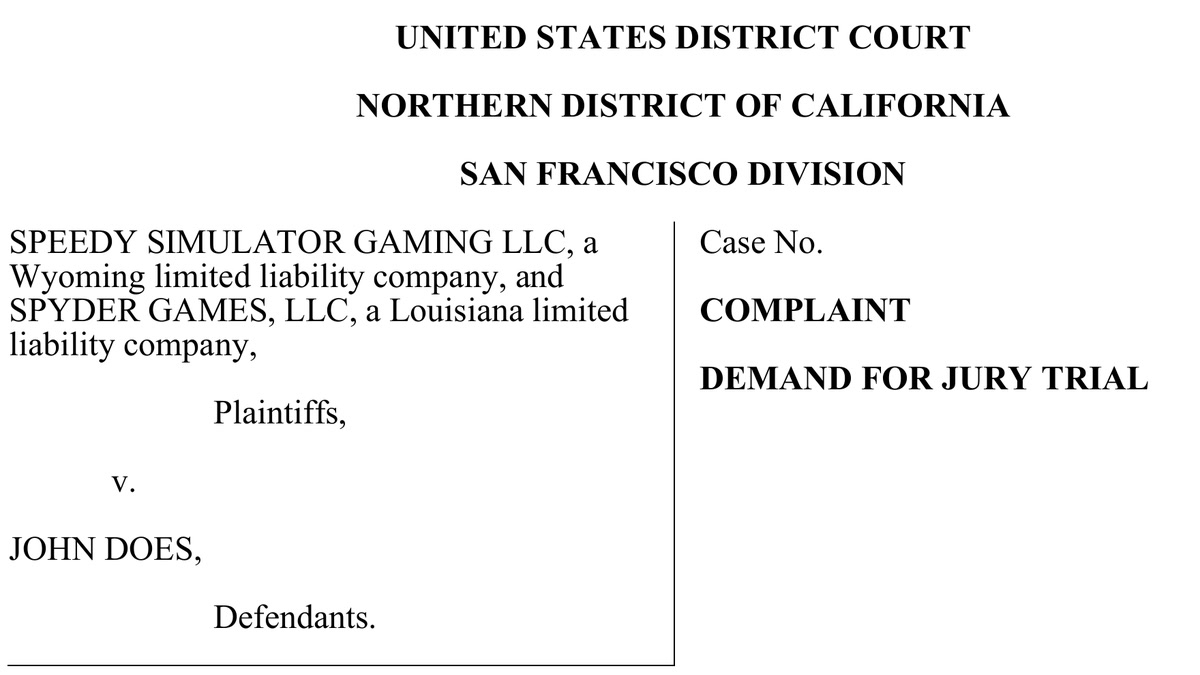
- Speedy Simulator Gaming LLC, a Wyoming company, and Spyder Games LLC, a Louisiana company, filed the five-page complaint on October 30, 2026, in federal court in San Francisco.
- These are claims from one side only.
The companies behind the Roblox game Steal a Brainrot have gone to federal court against two people known to them only by online nicknames. Their lawsuit says the pair broke into a Roblox account that held the game, planted a “backdoor” in its code that gave them administrator powers, and used it to hand out some of the game’s most valuable items.
Speedy Simulator Gaming LLC, a Wyoming company, and Spyder Games LLC, a Louisiana company, filed the five-page complaint on October 30, 2026, in federal court in San Francisco. It dates the break-in to “on or about October 22,” says the intruders later tried to sell the game on Discord, and says the developers had to take it offline.
These are claims from one side only. No court has ruled on them, and the online docket, last updated November 6, lists no response or lawyer for the defendants in the case, Speedy Simulator Gaming, LLC v. Does, No. 3:26-cv-12858.
How the developers say the attack worked
After getting into “one or more Roblox accounts” that held the game, the complaint says, the defendants downloaded its files. They then opened the game in Roblox Studio, the tool creators use to build Roblox games, and changed the code to give themselves administrator powers.
The changed version was then published to the live game without the developers’ knowledge, according to the filing. Using those powers, the defendants created “several of the most valuable in-game items” and gave them to themselves and other players, which the complaint says went around the game’s normal rules and economy.
How did they get in? The developers believe it began with a remote-access trojan, or RAT, malware that lets an outsider control a computer or account from afar. They say so “on information and belief,” a legal phrase for a claim based on what the filer has learned rather than first-hand knowledge.
The developers say they took the game offline to investigate, lock down the accounts and remove the bad code, and lost money while it was down.
Players noticed at the time. Videos on YouTube and TikTok titled along the lines of “Steal a Brainrot got hacked” describe rare items suddenly appearing in servers, though they do not show who was behind it.
Why the lawsuit names “John Does”
When people do not know who harmed them, U.S. courts let them sue placeholder defendants, called “John Does,” and try to learn the real names later. Game Empress is not printing the two nicknames in this complaint, because the people behind them have not been identified and their ages are not known.
Under federal court rules, a party generally cannot demand records from anyone before the two sides have held their first planning meeting, unless a judge allows it. Plaintiffs suing unnamed people can ask for that permission early. Denuvo did this in the same court in its lawsuit against the anonymous cracker voices38, and in October a judge let it subpoena Valve, Discord and Reddit for identity records after it narrowed its requests.
The CourtListener copy of this docket, last updated November 6, shows no such request. Its four numbered entries run through November 2, and none seeks early discovery or subpoenas to Discord or Roblox, though that mirror can lag behind the court’s own system.
One claim: the federal hacking law
The Steal a Brainrot lawsuit rests on a single law, the Computer Fraud and Abuse Act. It is a criminal law, but it also lets people harmed by a violation sue for damages and court orders. The developers rely on three parts of it:
- Getting in and taking information: accessing a protected computer without permission and obtaining information. The complaint says Roblox’s servers qualify.
- Getting in to defraud: accessing without permission, with intent to defraud, and obtaining something of value. The complaint cites the alleged sale attempt as proof of intent.
- Getting in and causing damage: accessing without permission and causing damage and loss. The complaint points to the altered code, the created items and the cost of the cleanup.
In a case like this one, a private lawsuit under the law needs at least $5,000 in losses within one year. The complaint says the losses exceed “the statutory minimum” but gives no dollar figure.
The developers want money damages and a jury trial. They also ask for an order keeping the defendants out of Roblox accounts that hold their games and stopping any sale or sharing of the game, plus every copy returned and destroyed and a list of everyone who received one.
The case so far, by date
| Date | What happened | Where it is recorded |
|---|---|---|
| About Oct. 22, 2026 | Alleged break-in into the Roblox account(s) holding the game | Complaint, paragraph 7 |
| Oct. 30, 2026 | Complaint filed; the companies also file a certificate of interested entities | Docket entries 1 and 2 |
| Nov. 2, 2026 | Case assigned to Magistrate Judge Sallie Kim; scheduling order issued | Docket entries 3 and 4 |
| Nov. 16, 2026 | Deadline to say whether the parties agree to have a magistrate judge, rather than a district judge, handle the case | Docket entry 3 |
| Jan. 25, 2027 | Case management statement due | Docket entry 4 |
| Feb. 1, 2027, 1:30 p.m. PT | First case management conference, by video only | Docket entry 4 |
Gaps in the developers’ account
The complaint leaves out much of what players might want to know. It does not say how long Steal a Brainrot was offline, which items were created, how many, or who got them. Nor does it say whose computer the trojan allegedly reached, or what price the game was offered at on Discord.
Roblox is not a party. It comes up because the complaint says the game files were taken from Roblox servers in California, one reason it gives for suing there. The suit also makes no copyright or trade-secret claims.
Steal a Brainrot on Roblox today
The game is playable again. When Game Empress checked the Steal a Brainrot page on Roblox and Roblox’s public game data at 3:46 p.m. PT on November 7, 2026, it showed 77,456 people playing at that moment, about 74.4 billion total visits and 29.7 million favorites. Roblox lists the game, created in May 2025, under the verified group “BRAZILIAN SPYDER,” and showed its most recent update earlier that day.
The Roblox page does not name either company in the lawsuit. The complaint calls Steal a Brainrot the plaintiffs’ “proprietary game,” and when Spyder Games sued the maker of a Fortnite map in October 2025, Aftermath identified the company as the game’s developer.
That earlier case had a named defendant. This one asks the court to make the defendants name everyone who received a copy of the game, yet for now the court record knows those defendants only by two nicknames.
Featured image: Promotional image from Steal a Brainrot’s Roblox page. Image: Brazilian Spyder / Roblox