
Mario, Sonic and the PlayStation: What the 1990s Console Wars Left Behind

- In the early 1990s, buying a video game console was rarely just a hardware decision.
- That is the real legacy of the 1990s console wars.
- Sega's Mega Drive went on sale in Japan on October 29, 1988, according to Sega's own hardware history.
In the early 1990s, buying a video game console was rarely just a hardware decision. The box under the television decided which games a household could play, and the advertising around it told players what kind of gamer they were supposed to be.
That is the real legacy of the 1990s console wars. Nintendo’s Mario and Sega’s Sonic gave the rivalry its faces, but the decade also brought Sony into the business, pushed the industry into age ratings and moved home games from flat sprites toward 3D worlds. Each of those shifts changed what companies made, who they made it for and how they sold it.
Sega sold an attitude
Sega’s Mega Drive went on sale in Japan on October 29, 1988, according to Sega’s own hardware history. It reached North America in 1989 under a different name, Genesis, and arrived in Europe as the Mega Drive in 1990.
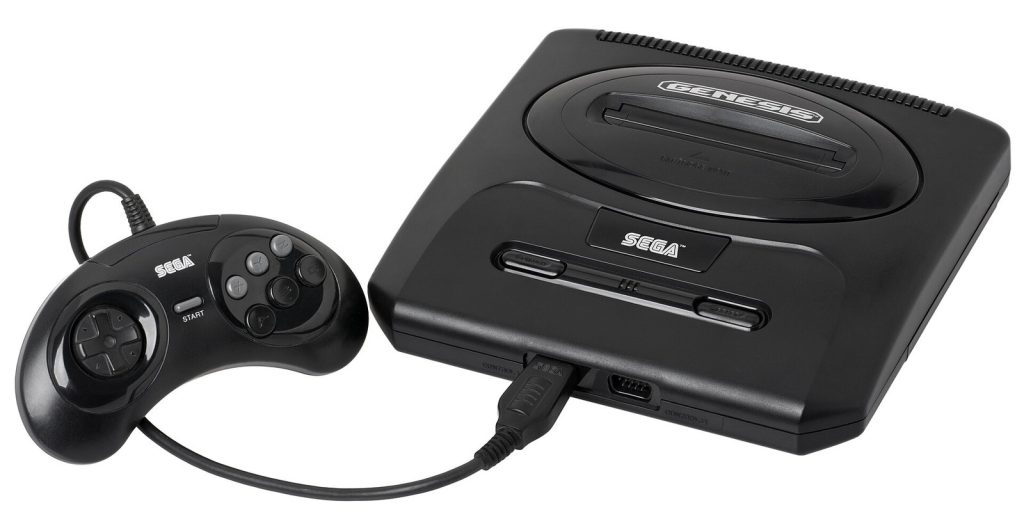
Nintendo was the company to beat. Its NES had defined home gaming for many families in the 1980s, and its image was friendly and family-oriented. Sega chose not to compete on those terms. In the United States, its advertising leaned into speed, sarcasm and a teenage edge, most famously with the slogan “Genesis does what Nintendon’t.”
The pitch was a marketing position, not a fact about who actually played what. Plenty of adults owned Nintendo systems, and plenty of children owned a Genesis. But the campaign turned a hardware purchase into something closer to a team badge, and it gave players a reason to argue about their choice.
Sonic the Hedgehog, which Sega’s company history lists as the start of the series in 1991, gave that attitude a body. A mascot was worth more than any one game: Sonic could sell the console, feature prominently in advertising and signal what Sega stood for. He was fast where Mario was steady, and that contrast was the point.
Why the games decided it
For buyers, the question was simple: what can I play on it? Exclusive games gave them a concrete reason to choose a system. Nintendo had Super Mario World and a deep library of franchises. Sega had Sonic and a growing list of games built around the Genesis.
Exclusives and mascots did not begin in the 1990s, but the rivalry made them more important. A strong exclusive did two jobs at once. It gave people a reason to buy a console, and it showed off what that console could do. The flip side was that choosing one system meant missing games on the other, unless a family could afford both.
Donkey Kong Country, released for the Super NES in 1994, shows how much one game could do for a platform late in its life. Rare built its characters and worlds as 3D models, rendered them in advance and turned the results into 2D graphics the console could display. The game still played as a 2D platformer, but it looked unlike anything players expected from existing hardware, and it gave the Super NES a fresh reason to be noticed.
One game, two versions: Mortal Kombat
The rivalry was not only about speed and mascots. In 1993, the home versions of Mortal Kombat exposed a real disagreement over who games were for.
Nintendo’s Super NES version removed the blood and toned down the game’s graphic finishing moves. Sega’s Genesis version also shipped without the blood switched on, but players could enable it, along with the more graphic content, by entering a code. The same game ended up reinforcing two different brand identities.
Sega had already prepared for that kind of controversy. In June 1993, it introduced its own Videogame Rating Council to label games by age. But separate company policies could not settle a wider public argument about violent games. In December 1993, U.S. senators opened hearings on video game content, with Mortal Kombat and the Sega CD game Night Trap among the titles that drew attention.
The industry’s response was the Entertainment Software Rating Board, established in 1994. The ESRB is an industry self-regulatory body, not a government agency. The ratings helped consumers distinguish games intended for different ages without requiring every game to follow the same content standard. Mortal Kombat was a major factor in that process, not its only cause.
Sony’s advantage was more than graphics
Sony’s route into the market ran through Nintendo. According to Sony’s corporate history, the two companies signed a contract in early 1990 to develop what became known as the Super NES CD-ROM. That project never reached the market. Sony engineer Ken Kutaragi argued that the company should build its own console instead, and Sony did.
The PlayStation went on sale in Japan on December 3, 1994, priced at 39,800 yen. Three decades on, Sony says it does not need to aggressively sell the PS5 as it looks ahead to the PS6. It launched in North America and Europe in 1995, according to PlayStation’s official history.
It is tempting to say Sony simply had better graphics. That explanation is incomplete. Sony’s own history puts heavy weight on the disc format. It says cartridges could take months to replenish once stock ran out, while its CD production and distribution system could fulfil even small orders within six days, with low production costs even for the large amounts of data 3D games needed. For publishers, that meant less risk: they could order smaller runs and restock quickly if a game sold well.
Sony also courted developers. Its history describes a library of basic programs and sample code designed to help studios that had little experience with 3D graphics. For a newcomer without Mario or Sonic, a steady stream of games from other companies was the way to compete with established franchises.
Sega was fighting on this front too. Its Saturn arrived in Japan in 1994 and in North America in 1995, where it faced Sony’s new PlayStation and a Nintendo preparing its next machine.
Into three dimensions
The mid-1990s also changed how games were played. Home consoles had mostly relied on 2D sprites. The new generation made real-time polygon 3D far more common, and that created new design problems. Players now had to move through space, judge depth and deal with a camera that could turn.
Nintendo’s answer was to design the hardware and the flagship game together. The Nintendo 64, which first launched in 1996, kept cartridges rather than switching to discs, and it came with a controller built around an analog stick. Nintendo is now revisiting that era with a remake of The Legend of Zelda: Ocarina of Time. The Digital Game Museum credits the Nintendo 64 and Super Mario 64 with helping popularize analog-stick controls, and describes how the controller was designed partly around the needs of the game while the game was built to show off the controller.
In Super Mario 64, how far a player tilted the stick decided how fast Mario moved, which suited open 3D levels far better than an eight-direction pad.
None of this made 2D games obsolete. Two-dimensional games kept appearing throughout the decade, and the best of them showed that a new technology does not erase an older way of making games. It gives designers another option.
Sega’s exit, and what it did not mean
Sega’s last new-generation home console, the Dreamcast, launched in Japan on November 27, 1998, and reached overseas markets in 1999. On January 31, 2001, Sega announced that it would concentrate on content, and its hardware history records that Dreamcast manufacturing would end by March 2001.
That was the aftermath of the 1990s contest, and it is often misread. Sega did not disappear. It withdrew from competing with new-generation home consoles and shifted its focus toward publishing games, including titles for its former rivals’ platforms. Its hardware exit also cannot be pinned on a single advert, launch decision or competitor. It showed that strong games are not enough on their own; pricing, timing, support from other developers and commercial execution matter just as much.
It also shows why it is hard to crown one winner of the whole decade. The Genesis-versus-Super NES years and the PlayStation, Saturn and Nintendo 64 years were different contests, and the answer changed by region and by period.
Still playing out in 2026
Sonic turned 35 this year. On June 23, 2026, Sega marked the anniversary with a livestream and a 35th Anniversary Project that includes newly made Sonic the Hedgehog 1 and 2 cartridges compatible with NTSC Sega Genesis consoles, and a Classic Sonic Collection for Nintendo Switch, which bundles Sonic Origins, Sonic Mania and Sonic Superstars and is scheduled for October 2026. A character created to take on Nintendo is being celebrated on a Nintendo console. Mario, meanwhile, has conquered cinemas: The Super Mario Galaxy Movie was the first 2026 film to cross $1 billion at the box office.
In our reading, that is the decade’s real inheritance. The 1990s console wars did not end with one company owning gaming. They established the terms that still shape it: recognizable franchises, hardware with its own identity, close relationships with developers, and a fight over which audience each company wants to speak to.
Featured image: An original PlayStation (SCPH-1000) with its controller. Photo: Evan-Amos / Wikimedia Commons (public domain)
